


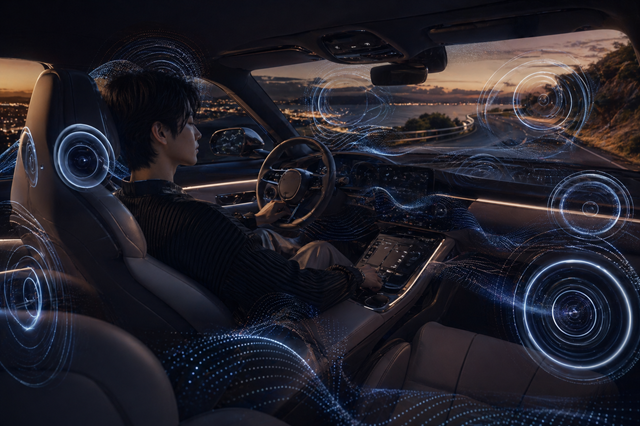
Introduction: Driving as a Listening Experience
There was a time when in-car audio was an afterthought—something bolted into the dashboard to fill silence between destinations. Speakers were functional, not foundational. The focus of automotive engineering was almost entirely mechanical: performance, handling, and reliability.
That hierarchy has shifted. Today, sound is no longer secondary in the driving experience—it is central to it. Cars are increasingly designed not just as transport systems, but as curated audio environments, where music, podcasts, and spatial sound design play a defining role in how a journey feels.
In many modern vehicles, motion and sound are now inseparable experiences.
From Radios to Sound Architectures
Early car audio systems were simple extensions of home radios. They delivered limited fidelity and were heavily affected by engine noise, road vibration, and cabin acoustics that were never designed for critical listening.
Over time, however, manufacturers began treating the cabin as an acoustic space rather than a functional interior. This shift has been driven by both technological advances and changing user expectations.
High-end systems now involve:
- Multi-speaker spatial layouts
- Dedicated subwoofer integration into chassis design
- Cabin materials tuned for acoustic reflection control
- Digital signal processing (DSP) tailored to seating position
Instead of simply playing sound, modern systems actively shape it. The car becomes an enclosed listening chamber, designed to control how audio behaves within it.
The Cabin as a Controlled Acoustic Environment
One of the most significant developments in automotive audio design is the level of control applied to interior sound environments.
Engineers now consider the cabin a fully mapped acoustic field. Every surface—from glass to upholstery—is evaluated for how it absorbs or reflects frequencies. Even the placement of air vents and storage compartments can influence resonance.
This level of precision allows manufacturers to create listening environments that are remarkably consistent regardless of external conditions. Whether driving through dense city traffic or along open motorways, the interior sound profile remains intentionally stable.
The goal is not just clarity, but immersion.
The Rise of Spatial and Immersive Audio
Modern audio systems are increasingly built around spatial sound principles. Instead of stereo left-right separation, sound is distributed in three dimensions, creating a sense of depth and positioning.
This is particularly noticeable in premium EVs and high-end models, where engine noise no longer masks subtle audio detail. Without combustion noise, manufacturers have been able to design audio experiences that are more refined and layered.
Key developments include:
- Object-based audio mixing that adapts to cabin geometry
- Seat-position calibration for personalised sound staging
- Real-time adjustment of audio balance based on speed and road noise
- Integration of streaming platforms with high-resolution audio support
The result is a listening experience that can feel closer to a live performance than traditional car stereo playback.
Electric Vehicles and the Silence Problem
The rise of electric vehicles has dramatically reshaped in-car audio design.
Without internal combustion engines, EVs remove a major source of ambient noise. While this creates a quieter driving experience, it also introduces a design challenge: the absence of natural sound feedback.
Manufacturers have responded in two ways:
- Enhancing artificial driving sounds for safety and feedback
- Doubling down on premium audio systems to fill the acoustic space
In many EVs, sound systems are no longer optional luxury features—they are central to the emotional experience of driving. Music becomes more prominent, more detailed, and more present.
Silence, in this context, is not emptiness. It is a canvas.
Music as Part of Vehicle Identity
As audio systems become more sophisticated, they also become more personal. Drivers are no longer just listening to music in cars—they are shaping how music is experienced in motion.
This has led to a subtle but important cultural shift: the car is now part of the listening identity.
Streaming platforms integrate directly into dashboards, allowing seamless transitions between home, phone, and vehicle environments. Playlists follow drivers across contexts, reinforcing continuity in personal soundscapes.
In this way, the vehicle becomes a curated extension of taste—similar to how headphones or home speaker systems reflect audio preferences.
The Psychology of Sound in Motion
Sound in a moving vehicle has a unique psychological effect. Unlike stationary listening, driving introduces constant motion, visual change, and cognitive engagement. Audio becomes a stabilising force in this environment.
Research in human perception suggests that music in motion can:
- Reduce perceived travel time
- Improve focus during long journeys
- Influence driving mood and behaviour
- Enhance emotional connection to driving experiences
Manufacturers are increasingly aware of this relationship. Some systems now adapt playback based on driving style, adjusting tempo or intensity subtly in response to acceleration patterns or route type.
The car, in effect, becomes responsive not only to driving behaviour but to emotional context.
When Engineering Meets Curation
What distinguishes modern automotive audio systems from earlier generations is the level of curation involved.
Sound is no longer simply transmitted—it is designed, layered, and tuned. Acoustic engineers work alongside software designers and even music specialists to ensure the listening experience aligns with brand identity and user expectation.
This creates a convergence between engineering and cultural production. The car becomes a platform where audio content is not just played, but experienced in a controlled and intentional environment.
Audio as a New Form of Automotive Luxury
In earlier eras, luxury was communicated through visible materials and performance figures. Today, one of the most subtle indicators of premium automotive design is sound quality.
A well-designed audio system does not draw attention to itself. Instead, it removes distraction, creating clarity and presence within the cabin.
This aligns with broader shifts in automotive design, where refinement is increasingly defined by what is absent—noise, vibration, and interference—rather than what is added.
Even personalisation trends in the automotive world reflect this broader move toward subtle identity expression. Companies like Number 1 Plates operate within a wider culture of vehicle individuality, where owners express identity through detail-oriented choices rather than overt display.
Conclusion: The Car as a Moving Listening Room
The evolution of in-car audio reflects a deeper transformation in how vehicles are experienced. Cars are no longer just machines that carry us from place to place—they are environments that shape perception, mood, and attention.
As sound systems become more advanced and cabins more acoustically refined, driving increasingly resembles a curated listening experience rather than a purely mechanical one.
In this context, motion and music are no longer separate elements. They are layered together, forming a unified experience where the journey is defined as much by what is heard as by where one is going.
The modern car, in many ways, is no longer just a vehicle. It is a moving audio space—designed not only to transport bodies, but to shape how time itself is heard.