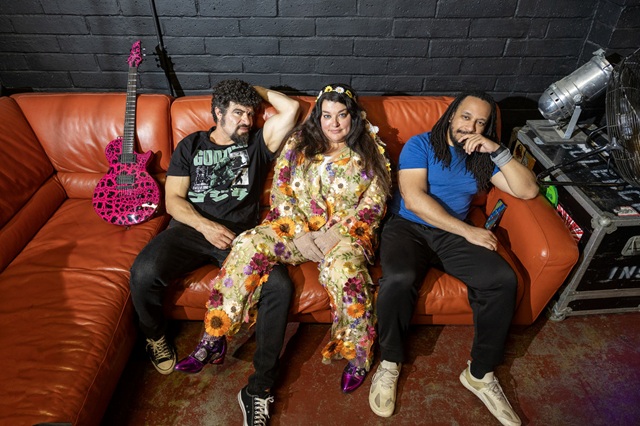


We chat with The Discretes about their collaborative proecess, creativity, and more surrounding their new album Immersive new album In Sore Bless, which weaves art rock, ambient, noise, and trip-hop influences into a captivating listening experience
How did the two of you initially connect, and what sparked the decision to collaborate as The Discretes?
We met at a Diamanda Galas concert in NYC. We were seated next to each other and after the concert, we were both under Galas’ spell and lingered for a while talking about the experience. We briefly talked about our own projects and CECILIA told me about her current projects including a new record she was working on. That record eventually became Adoration released on Halcyon Veil. I got a copy of the LP when it came out and became a fan. That coincided with a transitional period for me, not having enough time to commit to playing in a band and working on occasional solo projects. I also became interested in electronic and synth sounds and more importantly, wanted to follow up on my long term aspiration to collaborate with a singer. We had kept in touch, occasionally sharing works in progress and I began to get a stronger sense of CECILIA’s intuitive creativity and story telling, both of which I admired. I asked if she’d be interested in a collaboration and presented a couple of instrumental drafts as examples. She graciously agreed and we decided to make a record together.
CECILIA, after over a decade of producing your own solo work, In Sore Bless marks your first time stepping strictly into the role of vocalist. What was it like letting go of instrumental control and relying entirely on Ali’s production?
I think somehow the challenge of letting go of control was the whole point, a big part of the excitement to do this project. I was surely scared to ‘just’ sing, it was definitely outside my comfort zone. I never thought of myself as a singer. Although my voice is very important and often the center of gravity in the making of my music, I use it more as the voice of an actress I would be directing to lead my psychic script. I’ve always felt that this voice could only fit within the context of my own productions, that it could only serve and make sense within my own world.
But then, the instrumental demos Ali sent me were beautiful and moving enough that I felt inspired to focus only on vocals. They also sounded fresh to my ears, different enough from what I do, and from the collaborations I’d done previously, to pique my curiosity and spark my drive. I saw it as an opportunity to challenge myself as a singer and lyricist, and have fun with it. Writing lyrics is something I’ve never really separated from composition, recording, or even mixing. In my own work, all of these processes overlap and inform one another. I’ve also always relied heavily on improvisation with all of these elements when composing. But this time I had to approach the writing in a slightly more conscious and deliberate way. It was quite instructive.
The concept of creativity acting as a “bandpass filter” — cutting through life’s noise to focus on what moves you — is a central theme of this release. How did that philosophy guide the actual writing and recording sessions for the record?
A bandpass filter is the equivalent of zooming in, zooming out and focusing but in audio. You pick a center frequency which is your focal point, and then dial in a narrow or wide range of frequencies around that frequency. A common technique is to set a narrow bandpass filter to sweep a range of frequencies to hone in on a frequency you want to amplify or conversely to sweep for a frequency you want to reduce.
We all exist in life’s noise which can blur our focus and make it a struggle to listen and hear clearly, to find an un-fractured perspective, to find balance. Creativity is a way to refocus. You hone in on the frequencies you want to amplify and at the same time also reduce interfering frequencies. It’s a fitting analogy and in practical terms, during the production of the record, the acts of focusing, zooming in or out, become tools in cultivating and maintaining creative momentum. We can apply the same ideas to a workflow where we regularly alternate a narrower and wider focus, where we add layers to achieve greater density or strip layers to create space, experiment and come back with fresh ears after working on a different song.
Are there specific writers or artists whose presence felt particularly strong while working on these songs?
CECILIA — I personally found myself returning to the poetry of Marie Uguay, a Québécois poet I love. She only published one collection before dying of bone cancer in 1981, at the age of 26. Her writing is visceral, rooted in a body struggling on the edge of death, yet filled with an intense desire to live and a deep awareness of the sensual miracle of being alive. I was also rereading Fires (Feux) by Marguerite Yourcenar, which to me is her most intimate and poetic book. She speaks through reimagined figures from Greek mythology to process her own experiences of love, loss, and destruction. Reading it was like listening to a devastated post-catastrophe piece of music, shattered but still in motion, unraveling vivid visions of tragic events. And then there was Dalida, not so much her music as her presence, almost as a mythological figure. At some point during the recording of In Sore Bless, I was watching a lot of her interviews and listening to her songs, so moved by the way she carried grief, melancholy, longing, and glamour all at once.
Ali, given your background in recording and noise experimentation, how did CECILIA’s vocal approach influence the way you structured and layered the instrumentals around her voice?
CECILIA’s work contains an innate experimental dimension which was immediately engaging to me and I took many cues from her music. I imagined a starting point as a rough sketch, just the seed of a rhythm and harmonic background, somewhat minimal and fairly repetitive. The idea was to provide a staging ground and space for CECILIA to build a narrative and her vocals on. The driving melodies are all her singing and in some instances instruments were added to accent her vocals.
I would say my approach in establishing a base or fundamental vocal track was fairly traditional but open to more experimentation and exploration in trying to shape certain sonics, combining or alternating a more intimate proximity and a more spacious, ethereal sound.
The tracks move fluidly between English, French, and Italian. What usually dictates which language best suits a particular song, and does shifting languages alter the vocal energy or delivery?
Nothing besides intuition and trial-error dictates which language I’ll sing in, it all happens quite simply and naturally. Each language surely has its own energy and contours of delivery, reflecting my relationship with each one. In French, I feel more playful and free to deconstruct language and explore the sound of words, although I’m also more critical and easily prone to cringing. That gives a kind of restrained feel and contemplative mood I think. I like English to work with simpler ideas and a more direct emotional language; play with clichés and love song/pop song familiar tropes. There’s something more immediate about it, where simplicity can create a clear impact. I rarely write in Italian. When I do it’s mostly as pedagogical exercises to keep learning and improving. But for Remedium, I went back to a diary fragment from 2018, a letter I never sent to a crush I had while living in Napoli. It seemed like it had been written by a ten-year-old. I couldn’t really explain why I wanted to use it.
From four-track tape to detuned oscillators, the record carries a very tactile, analog weight. What key instruments, gear, or studio techniques were crucial in capturing the album’s distinct soundscapes?
As a mainly long distance collaboration, production was an incremental process. We invested more time in the early stages, into trying to define the sounds and approaches that we liked and inspired us the most. As an interesting collection of sounds began to emerge, our workflow also evolved. In the recording phase, we followed an “all is fair” approach out of necessity so the means and methods were a medley of spaces and gear. The anchor environment was the venerable institution of home recording with occasional use of a studio, and a rehearsal space. There was an assortment of gear, fairly inconsistent as a whole among the songs. In the mixing phase, we were able to get a good chunk of consecutive days dedicated to further sound shaping and overall cohesion.
To list some specific gear – vocals used various mics but most of the takes on the record used a Sennheiser MD 441-U. On acoustic guitar, I tried different mics but what made the biggest difference was using flat wound strings. Mixing is where everything came together and passed through a predominantly analog chain twice. One pass through an APB Dynasonics H1020 mixer to make instrumental and vocal stems and another pass printing the stems onto tape on a TEAC A-3340. A notable compressor I’d like to mention was a SKnote Vastaso and a notable equalizer, the GOLY PQ2. For time based effects, a Jomox T-Resonator II and the Meris Mercury7 helped push sounds further. I can’t say there were any secret or ground-breaking techniques, just repeated passes or explorations, not to achieve a hi-fi sound but a warm, brooding, resonant, thick or patinaed (as CECILIA likes to describe it) sound, as suits best the expression of the song.
If you could collaborate with any artist, alive or dead, who would it be?
Ali – This is an intimidating question! Going with the dead option, I’d like to take the opportunity to time travel to pre recorded music times or perhaps to the early days of the wax cylinder. It would be interesting to undertake a musical tour of the world, armed with a good digital handheld recorder, ca. 900 AD. Or take a drone-y synth and an electric guitar to early 1900’s Istanbul and jam with Tanburi Cemil Bey.
CECILIA — Spontaneously, without thinking too much about it, I would say the contemporary dance theatre company Peeping Tom, founded by Gabriela Carrizo and Franck Chartier and based in Belgium. Making an original score for one of their shows would definitely be a dream. Their language and aesthetic speak right through me. Hyperrealist settings are shaken and broken wide open, and we, spectators become voyeurs, witnessing scenes that feel like we shouldn’t see. Also,I have been contemplating the idea of sending an instrumental to Brigitte Fontaine for years, but never found the actual courage. She is my favourite living poet, singer and graceful rebellious soul. She is beyond. And in the dead category, I’d say I would like to write a romantic duet with Chet Baker.
What do you find is the most satisfying part of being an artist?
Ali – The most satisfying part is connecting with people in an evocative or thought provoking way. Music especially can appeal at a primal and emotional level. With its transient and fleeting nature, it’s a very human form of expression. You create a framework and it takes on a life of its own. It’s a latent spark that might make someone curious, or console them, give someone else a sense of balance or a certain perspective, maybe even become part of a cherished memory.
CECILIA – I don’t think I can speak of my joy of creating in terms of satisfaction. What I deeply love, even in the most painful moments of the process, is the research/active listening that makes me feel intensely alive, raw, present to the world. A wandering, a radical escape, which nevertheless grounds me and anchors me back in existence. Something intimate, yet strangely uncanny, almost foreign to me, something that is mine and at the same time exceeds me, does not belong to me.
There is a joy in digging, in unearthing, like an excavation of the psyche or the soul. Very, very rarely, something comes out of me that I am surprised to encounter, something foreign to myself. I feel like a voyeur. It can even make me uncomfortable, or make me feel a kind of embarrassment, but at the same time I know that it is right and true. This feeling is incredibly rare and vanishes quickly. Ultimately, that is what gives me the strongest sense of truly existing in my own singularity however nuanced or contradictory it may be.
All the rough and sharp edges of experience, all the cognitive dissonances and paradoxes can somehow be reconciled and held together within the invisible, intangible, dreamlike fiction of a piece of music. It is an absolute reconciliation of an irresolvable conflict. It’s an existential necessity that is prior to the coming of a listening.