


Got boxes of shirts taking over the practice space and cassettes stacked by the kit? You’ve already paid for the press run; now you need a platform that can move merch, track sizes, and ship orders without calling a print-on-demand factory.
We compared U.S. fees, shipping-label tools, and tour-table features on each platform’s own pages as of October 6, 2026, and landed on five clear “best-for” picks:
- Shopify for rock-solid operations
- Spark (spark.site) for a custom band site that sells merch and fan memberships together
- Big Cartel for tight budgets
- Bandzoogle for an all-in-one band site
- Bandcamp for discovery and vinyl-plus-download bundles
Read on to see where each platform shines, and where it stumbles, so you can choose the least stressful path to your next sold-out run.
How we evaluated the platforms
We looked at every storefront through a band’s real-world workflow, from counting sizes in the van to printing labels at 2 a.m.:
- Operations: variant-level stock, in-app postage, and tracking emails.
- Total cost: monthly plans, platform cuts, and processor fees, all pegged to U.S. prices current on October 6, 2026.
- Music-specific selling: downloads with vinyl, pre-orders, and mailing-list tools.
- Fan data control: custom domains, exports, and email.
- Tour and in-person sales: point-of-sale apps that sync with online inventory.
- Ease of setup: how quickly a band can go from signup to first live product.
- International tools: taxes, duties, and shipping destinations.
Where a platform’s own pages don’t list a feature, we say so plainly rather than guess.
Quick look: which platform fits which band?
No two bands share the same blend of budget, gear hauls, and fan habits. Use the cheat sheet below to spot your most likely match before we dive in.
| Platform | Best for | Starter cost | Platform fee on merch | Inventory | Music-bundle ready? | Tour POS? |
| Shopify | Serious operations and touring acts | $29 a month billed yearly (Basic) | 0 percent when you use Shopify Payments | Up to 2,048 variants per product | Via apps or Bandcamp sync | Sell in person on every plan |
| Spark | Custom band site with merch and a fan club | $25 a month (Starter) | 10 percent Starter / 5 percent Pro | Catalog and management tools built by Spark | One-time purchases and subscriptions | Not listed |
| Big Cartel | Small catalogs and tight budgets | $15 a month (Platinum) | 0 percent | Inventory tracking | Physical and digital products | Sell in person from your phone |
| Bandzoogle | One-stop band site plus store | $14.16 a month billed yearly (Standard, merch) | 0 percent | Inventory tracking on Pro | Music, merch, and pre-orders | Not listed |
| Bandcamp | Discovery and vinyl or cassette bundles | Free account | 10 percent on physical items | Item options and quantities | Physical + digital | Not listed |
Read top to bottom, then gut-check against your own reality. If you juggle dozens of sizes and play shows every weekend, Shopify is the reliable workhorse. Spark suits bands that want merch, a paid fan club, and members-only extras on one custom site. Press a hundred cassettes at a time and headline Midwest dives once a month? Big Cartel keeps costs in line. Bandzoogle wraps a band website around the store, and Bandcamp funnels new fans straight to checkout.
1. Shopify: best overall for bands ready to run a real retail operation
Website: shopify.com
Quick take
Shopify is less a site builder and more a compact retail stack. Open its dashboard and you’ll see inventory counts, payments, and shipping-label shortcuts side by side, a blend that lures touring artists once back-of-van spreadsheets stop working.
Cost is predictable. Basic costs $29 a month billed yearly, and online card rates through Shopify Payments start at 2.9 percent + 30¢. If you use a third-party payment provider instead, Shopify adds a 2 percent transaction fee, so most bands stick with Shopify Payments.
Growth is smooth, too. Since October 2025, every merchant can create up to 2,048 variants per product (with up to three options, such as style, color, and size), and stock syncs across your web store and in-person sales without duplicate entries.
Shipping, POS, and music sync
Getting merch out the door is where Shopify earns its keep. In the same admin where you add a long-sleeve, you can buy and print discounted shipping labels (Shopify advertises up to 87 percent off) and send tracking to fans.
On the road, the process stays tidy. Shopify’s plans include selling in person: open the Shopify POS app on a phone or tablet, tap the size, take payment, and the item comes off your stock count. No late-night spreadsheet edits after a sweaty club load-out.
Music integrations close the loop. Shopify’s Spotify integration can show eligible merch on your Spotify artist profile, and Bandcamp Sync for Shopify, a beta app for Bandcamp Pro and Label accounts, keeps inventory aligned between the two platforms with Shopify as the source of truth.
2. Spark: best for a custom band site that sells merch and fan memberships
Website: https://spark.site
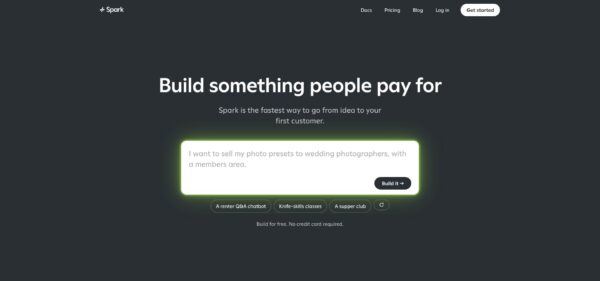
Open Spark’s home page and the first thing you see is a chat box for plain-language prompts, not a template grid. Describe something like “I need a band site with a merch rack and fan club,” and Spark builds the pages, customer accounts, and a Stripe checkout, with no code. Hosting and HTTPS are included, and you can connect a domain you bought from any registrar. Payments run through your own Stripe account, where you also manage refunds and payouts.
What Spark offers out of the box
For a store, you tell Spark what products you sell and how customers receive them, and it builds the catalog and the tools to manage it. Physical goods already sell on Spark: Pretty Postcard, one of the businesses on Spark’s home page, sells postcards at $5 each.
Because Spark sells both one-time purchases and subscriptions, a band can put shirts, cassettes, and a monthly fan club on the same site. Fans sign in with email codes, and Spark can add members-only pages and live chat rooms. After launch, Spark helps you plan and run marketing campaigns across channels.
What to plan for
Spark is not a print-on-demand service, so you print, pack, and ship yourself, which is exactly the setup this list is for. Spark’s site doesn’t list built-in shipping-label printing, carrier-rate calculation, or a point-of-sale app, so pair it with a label tool and log table sales yourself. Prices are set in US dollars.
On cost, you can build for free, but publishing and selling need a paid plan: Starter at $25 a month with a 10 percent fee on sales, or Pro at $200 a month with a 5 percent fee, plus Stripe’s processing fees. For a merch-only store with thin margins, Big Cartel’s flat $15 is cheaper; Spark makes more sense when the fan club and site matter as much as the shirts.
3. Big Cartel: best low-cost storefront for small catalogs
Website: bigcartel.com
Quick take
Big Cartel is the punk venue of ecommerce: bare-bones, friendly, zero pretension. The Platinum plan costs $15 a month after a 7-day free trial, takes no percentage of your sales, and supports custom domains, physical and digital products, and shipping labels with order tracking. A limited free Gold plan exists if you only need a few products.
Cost control is the hook. Your payment provider (cards, PayPal, Afterpay and more) charges its own processing fee, but Big Cartel itself doesn’t take a cut. For a band shipping a few dozen orders a month, that predictability often beats any revenue share.
The ceiling is lower. You get fewer integrations and lighter analytics than Shopify, though Big Cartel connects to more apps through Zapier on its Diamond plan.
Stock, shipping, and launch tools
Platinum includes inventory tracking, unlimited label printing with up to 90 percent off shipping, shipment tracking, bulk product editing, and a sales tax autopilot. The Big Cartel mobile app for iOS and Android lets you sell in person and take payments from your phone, so table sales come off the same stock count.
Need a midnight drop for the new 7-inch? Diamond ($30 a month) adds scheduled product drops, password-protected products for superfans, and abandoned-cart recovery.
Taken together, Big Cartel covers the launch-to-label loop for pocket money.
4. Bandzoogle: best all-in-one band website and store
Website: bandzoogle.com
Quick take
Bandzoogle bundles the core tools a working band needs under one roof: site builder, music player, tour calendar, EPK, mailing list, fan subscriptions, and a store, with 0 percent commission on sales. Merch selling starts on the Standard plan at $14.16 a month billed yearly ($17 month to month); Pro costs $18.33 a month billed yearly ($22 month to month) and adds ticket sales, unlimited pages and tracks, and advanced selling tools.
That consolidation pays off when you juggle multiple logins. Update a tour date, schedule an album pre-order, send an email newsletter, and post a blog recap without leaving the dashboard; the store inherits your site’s styling automatically, so pages feel cohesive rather than bolted on.
Bandzoogle also speaks the language of physical music. Vinyl, cassettes, CDs, and downloads sit next to shirts and zines, with download codes, product bundling, and album pre-orders on its feature list.
Inventory, shipping, and fan data in one place
Inventory tracking is available on the Pro plan; sold-out products automatically show as out of stock.
Shipping can run through EasyPost: connect a free EasyPost account and you get rates and label purchasing from 100+ carriers, including USPS, UPS, FedEx, and DHL, plus package tracking.
Fan data stays where you can use it. Buyers can join your mailing list, and the same email tools you use for show announcements reach them. Bandzoogle’s plans don’t list a point-of-sale app, so table sales need manual stock edits later; touring bands may still prefer Shopify’s shared inventory.
5. Bandcamp: best discovery channel and release-linked bundles
Website: bandcamp.com
Quick take
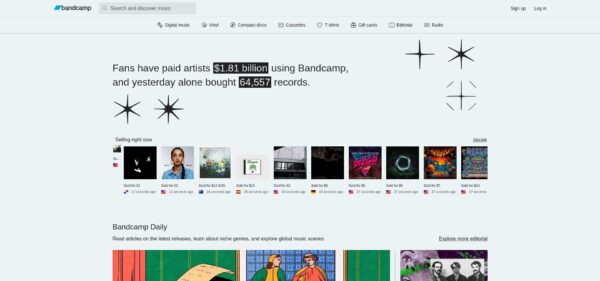
Bandcamp is less a storefront and more a never-ending record fair. Fans browse by genre tags, follow collections, and arrive on your page ready to support. You can include the digital album with a vinyl or cassette, which fuels the “support the artist” vibe behind Bandcamp Fridays, when Bandcamp waives its share.
Artist accounts are free. Under its Fair Trade Music Policy, Bandcamp keeps 10 percent of the base price of physical items (not shipping or tax) and 15 percent of digital sales, dropping to 10 percent once your all-time sales pass $5,000. Payment processing fees are separate, and Bandcamp pays out daily. That cut can sting once volume grows, but early-stage bands often trade margin for discovery.
Inventory follows a musician-friendly flow. Set item options and quantities, assign shipping origins if you pack from more than one place, and launch a pre-order while fans stream a teaser track.
If selling vinyl to strangers who land on your page on a Friday afternoon is the goal, Bandcamp still tops this list.
Shopify vs. Spark vs. Big Cartel: the short version
Many bands weigh these three because they sit at clear points along a control-versus-cost spectrum.
| Shopify | Spark | Big Cartel | |
| Core vibe | Full retail stack | Custom band site and fan hub | Lean artist cart |
| Starter price | $29 a month billed yearly | $25 a month + 10 percent | $15 a month |
| Platform fee | 0 percent with Shopify Payments | 10 percent Starter / 5 percent Pro | 0 percent |
| Inventory | Up to 2,048 variants | Catalog built by Spark | Inventory tracking |
| Shipping labels | Built in, discounted | Not listed (use a label tool) | Built in, discounted |
| POS for shows | Shopify POS app | Not listed | Big Cartel mobile app |
| Subscriptions / fan club | Via apps | Built in | Not listed |
| Custom flexibility | App ecosystem + Liquid code | Prompt-built pages | Theme tweaks |
Sell in person every weekend and ship hundreds of parcels a month? Shopify’s label-plus-POS combo keeps the chaos under one roof. Want a paid fan club and merch on one custom site? Spark builds both from a chat. Watching every dollar? Big Cartel costs $14 a month less than Shopify Basic on a yearly plan while covering the basics.
Operations muscle, custom fan hub, or plain-vanilla economy: pick one and build from there.
When a two-platform setup makes more sense than one
One store keeps life tidy, but many bands earn more by letting each platform do what it does best.
The classic pair: Bandcamp + Shopify
Bandcamp’s marketplace helps new listeners discover your record. You pay the 10 percent share on physical items, and the fan can walk away with a download. Shopify then handles tour-table sales, shared inventory, and label printing. With the Bandcamp Sync for Shopify beta, the two catalogs can share stock counts.
Running lean? Bandcamp + Big Cartel
Keep Bandcamp for discovery and swap Shopify for Big Cartel Platinum at $15 a month. The trade-off is manual inventory reconciliation between the two stores, so budget a few minutes after each show.
Skip the split
Some artists stay on Bandzoogle because its site-store-email bundle handles everything unless they tour heavily or need a marketplace.
Rule of thumb: if discovery drives half your orders, keep Bandcamp in the mix. If shows and high SKU counts dominate, add a retail cart with real inventory controls to protect margin and your sanity.
How to choose based on your monthly merch volume
Sales volume, not follower count, should determine where you plant your store. Use the guideposts below, then check them against your own margins.
- Under $200 a month: keep fixed costs tiny. A free Bandcamp account or Big Cartel Platinum at $15 leaves more cash for strings and gas. Bandcamp’s 10 percent share hurts less when the pie is small.
- Around $500 a month: Bandcamp now takes about $50 in platform fees on physical items. Big Cartel ($15) or Bandzoogle Standard ($14.16 billed yearly) locks cost to a flat rate.
- $1,200 to $1,500 a month: Shopify Basic at $29 (billed yearly) usually beats percentage models, and the built-in POS and label discounts start to pay for themselves once you handle a few dozen orders a week.
- $4,000+ a month: re-run the math. Percentage fees, such as Bandcamp’s 10 percent or Spark’s 5 to 10 percent, add up fast at this level, and Shopify app costs can grow. Most bands here mix channels.
Rule of thumb: when a platform’s monthly take matches or tops a competing flat fee, it is time to jump. Saving margin today funds tomorrow’s repress.
Shipping merchandise without destroying the margin
Postage is where profit leaks. A light cassette that sells for $8 can lose a big share of its revenue if you guess the weight or pick the wrong box.
- Weigh every product packed and taped. Record the “ready” weight; carriers charge for the full parcel.
- Match service to weight and distance. Stickers and patches fit stamped envelopes. Vinyl often works best with USPS Media Mail plus a rigid mailer. Let your cart pull real-time rates so buyers in Texas do not subsidize buyers in Tokyo.
- Track price changes. Carriers, including USPS, adjust rates from time to time, so refresh any rate table you keep after each change.
- Batch-print labels inside your platform. Shopify, Big Cartel, and EasyPost-connected Bandzoogle all print labels and add tracking, savings that add up over a hundred shipments.
International orders, VAT, and sales tax
Shipping abroad feels exciting, until a parcel bounces in Germany for unpaid VAT. Each platform handles compliance differently, so build the workflow before you tick the “worldwide” box.
- Shopify. Offers tax collection tools and international selling features that can collect duties and import taxes at checkout in many markets.
- Spark. Payments run through your Stripe account in US dollars; plan your tax setup with Stripe and your accountant.
- Big Cartel. Includes a sales tax autopilot on paid plans; check how it covers the countries you ship to.
- Bandzoogle. Check the store’s tax settings and your payment provider before you open international shipping.
- Bandcamp. Handles VAT on digital sales in many regions; review its help center for physical-goods rules where you ship.
Basic playbook:
- Register for sales-tax permits in any U.S. state where you pass economic nexus.
- Use HS codes on customs forms so border agents know a vinyl record is not lithium batteries.
- Offer delivered-duty-paid options on high-value items to avoid surprise fees for fans.
- Recheck thresholds every January; governments love quiet policy tweaks.
Taxes are just another part of the merch game plan: annoying, but solvable with the right settings and a calendar reminder.
A practical sustainability playbook
Self-fulfillment puts every box, tape roll, and delivery mile under your control. Small tweaks can cut waste and costs without turning shipping into a science project.
- Pick the right mailer. Use rigid envelopes for stickers and zines, and 12-inch record mailers with corner protectors for vinyl. Oversized boxes add dimensional weight you, and the planet, pay for.
- Swap plastic tape for kraft paper tape. Water-activated kraft tape sticks well, recycles easily, and signals care before a fan opens the parcel.
- Bundle whenever possible. Shipping one tee and one cassette together uses less cardboard, fuel, and packaging than two separate boxes.
- Offer local pickup at shows. A simple “pick up at merch table” option can shift a dozen orders from the postal truck to your van, saving postage for the fan and emissions for everyone.
- Be transparent. Add a short FAQ note listing your mailers, tape, and why you chose them. Fans trust clear details more than a generic “eco-friendly” badge, and that trust drives repeat sales.
Small, consistent choices beat one big pledge. Audit materials once a year and adjust as new, greener options appear.
FAQ: rapid-fire answers to the questions bands ask most
What’s the best platform if we print and ship merch ourselves?
For operations and tour integration, Shopify wins. On a lean budget, Big Cartel or Bandzoogle keeps more dollars in your pocket. If you also want a paid fan club on the same site, look at Spark.
Is Big Cartel cheaper than Shopify?
Yes. Big Cartel Platinum costs $15 per month; Shopify Basic costs $29 per month billed yearly. Shopify rolls POS, deeper variant options, and label discounts into that higher fee.
Bandcamp or Shopify: which should we choose?
Use both if discovery matters. Bandcamp finds new fans; Shopify manages complex inventory, POS, and international sales.
Can Bandcamp sync with Shopify?
Yes. Bandcamp Sync for Shopify (in beta, for Bandcamp Pro and Label accounts) matches items by SKU and uses Shopify as the inventory source of truth.
How do we stop overselling stock at shows?
Run every sale through a POS that shares inventory with your online store. Shopify’s POS app does this, and Big Cartel’s mobile app lets you sell in person from the same shop.
Best platform for vinyl and cassette bundles?
Bandcamp lets you include the digital album with physical formats, and Bandzoogle supports download codes and product bundles.
When does a percentage fee cost more than a flat plan?
At around $290 a month in physical sales, Bandcamp’s 10 percent share equals Shopify Basic’s $29 yearly-billed rate.
Can we migrate later?
Usually. Most major platforms let you export product, customer, or order data, but you will rebuild page layouts by hand.
How should we price low-cost items like stickers?
Bundle them. A $2.99 sticker pays the same 30¢ per-transaction card fee as a $20 tee, so grouping items lifts effective margin.
Can we sell pre-orders before merch arrives?
Yes. Shopify, Bandzoogle, and Bandcamp all support pre-orders. Make delays clear on the product page and email updates as ship dates lock.
Conclusion
Still unsure? Note your monthly sales, SKU count, and touring plans, then revisit the quick-look table. Your best-fit platform usually jumps off the page once your own numbers are in view.